
- Connecting audio
- Audio PC
- Raspberry & Co
- All in Ones
- Bluetooth
- Chromecast
- Streaming audio player
- Music server
- USB Audio
- Real-time audio over IP
- FireWire DAC
- Multi-channel DAC
- NAS
- Remote control
- Vinyl rippers
- Acoustic materials
- Active crossover
- Active speakers
- Single driver speakers
- Invisible speakers
- Sound card
- Digital room correction
- Headphone
- Portable media players
Headphones
And now for something completely different…
The difference between listening to music using speakers or a headphone is striking.
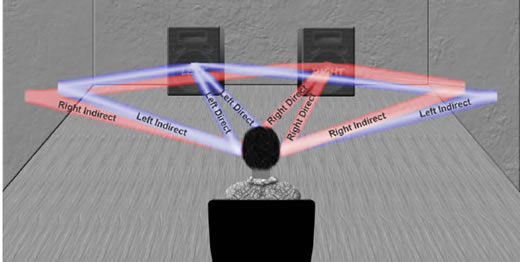
Stereo recordings are made to be listened to over a pair of speakers.
The left ear of the listener will hear the sound of the left speaker and a fraction later, the right ear will hear this sound too although slightly modified (HRTF, head-related transfer function).
The left ear will also hear the sound from the right speaker, this time it will be the one receiving the signal a fraction later.
Mutatis mutandis the right ear.
Above also applies to the indirect sound bouncing of the walls, floor and ceiling.
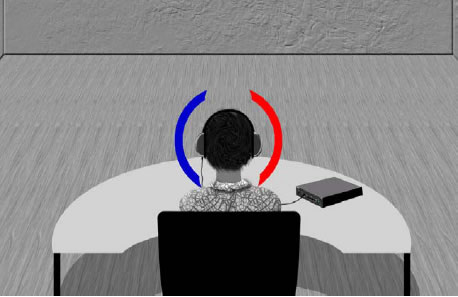
When listening to a stereo recording using a headphone, each ear will receive 1 and 1 channel only. No mixing, no delay, no indirect sound coming from the surfaces of the room.
The latter means that the room acoustics are eliminated.
The result is an increased spatialization, a barrage of details.
Stereo is simply not meant to be listened too this way.
However, if you are an avid headphone listener, you will get used to it over time.
A solution is a using a crossfeed. It simulates listening to speakers.

The place to discuss headphones for subjectivist.-

InnerFidelity was a website run by Tyll Hertsens.
Beside a subjective listening impression, he also measured the headphone.In 2018 AVTech Media Ltd (UK) acquires Home Tech Network.
Pretty soon after that , Tyll left Innerfidelity.
Innerfidelity was turned into a lifestyle oriented website full of the normal audiophile nonsense. In 2020 Innnerfidelity was terminated.
Tyll's legacy can be found here.

Lots of measurements here.
- Raw Frequency Response - Rtings