
- AccurateRip
- Acoustid
- AES/EBU
- AirPlay
- Amplifier
- aptX
- Audio file formats
- ASRC
- AVB
- Bit perfect jitter
- Bits: 16 or 24
- Bit perfect playback
- Bitrate
- Bluetooth
- Burn-in
- BWF
- Cables
- CDtext
- Chromecast
- Clipping
- Clock
- Codec
- Compression
- CRC
- Crossover
- Cue sheet
- DAC
- Damping
- DASH
- Digital
- Digital Room Correction
- Dither
- DLNA
- Drivers
- DoP
- DSP
- EBU R128 (loudness)
- FFT
- FireWire
- Freedb
- Gapless playback
- Generation loss
- HDMI
- Headphone listening
- Hearing
- Hires recording
- Homeplug
- I2S
- ID3
- Inter sample peak
- LDAC
- Linearity (DAC)
- Memory playback
- Music Server
- OCF
- OFC
- PCM
- Perception
- RAID
- ReplayGain
- Ripping
- RFI
- RIAA
- Router
- Sampling, up and over
- Sample Rate Conversion
- Speakers
- S/PDIF
- Storage
- Sync
- Tagging
- Toslink
- Transcoding
- UAA
- Units
- UPnP
- USB
- VST
- WiFi
- WiSA
Connecting speakers
Conventional
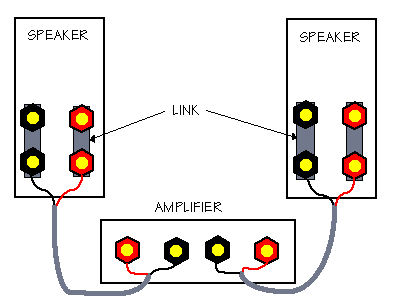
The 2 terminals of the amp are connected with the corresponding terminals of the speakers.
Bi-wiring

Today a lot of speakers do have 2 sets of terminals bridged by a jumper.
Remove the jumpers and run separate cables from amp to the speaker terminals.
A bit more on bi-wiring.
Bi-amping

You can use one 2 channel amp to drive the woofers and another to drive the tweeters.
This is called horizontal bi-amping

You can also use one 2 channel amp for each speaker, using 1 channel for the woofer and the other for the tweeter.
This is called vertical bi-amping.
Bi-amping makes amplifier's life a bit easier.
Normally a single channel faces a high and a low pass filter connected to a tweeter and a woofer.
In case of horizontal Bi-amping each channel either faces a low pass filter and a woofer or a high pass filter and a tweeter.
Woofers are the power hungry ones. If you go vertical, each amp has only to feed one woofer. If it is about playing louder without distortion, vertical is the way to go.
Bi-wiring and bi-amping are typical for the audiophile community.
There are better solutions like the active crossover.
Active crossover

In the eighties the pro-world discovered that you could improve the transparency of speaker systems if you remove the crossover from the power path.
Simply do the crossover on the line out of the pre-amp.
In our opinion, the best method of connecting your speakers is to supply one amplifier per voice coil and eliminate the speaker's built-in crossover. If your speaker is a three-way design, then you must "Tri-Amplify" your speaker. This technique, however, is not for the feint of heart because you must be prepared to modify your speakers and take some measurements. Individual driver efficiency varies. The original speaker crossover equalized these variations. After eliminating the original crossover, these sensitivity variations must be accounted for by your crossover or amplifiers. Another loose end is the fact that some speaker designers deliberately connect the midrange out of phase. For anyone willing to take the trouble to devote one amplifier to each voice coil, the sonic rewards are outstanding. We can recall an unforgettable lesson many years ago when a manufacturer had two versions of the same loudspeaker. One version used the traditional set-up, the other was Bi-Amplified using built-in amplifiers. Even though the amplifiers used for the Bi-Amplified version were nothing special, the self amplified version always sounded better than the passive version, even when driven by our best amplifier using our best speaker wire.
The DJ Society
As you can see in the text above, The DJ Society is talking about bi-amping too.
In general if the audiophile community talks bi-amping they mean driving a passive speaker with two identical amplifiers.
If the pros talk bi-amping they mean connecting the amp straight to a speaker without a passive crossover and doing the (active) crossover between the pre-amp and the power amp.
More about active crossovers.
Active speaker

Place the active crossover and amps into the speaker cabinet and you have an active speaker.
Often a low power amp is used for the tweeter and a high power one for the woofer.
No need to use identical ones.
Almost all studio monitors are build this way.
Slowly active speakers targeting the home appears on the market.
More about active speakers.
Powered speakers
Observe that not all speakers with built-in amplification are actives speakers.
You can place the amp inside the box and drive the speakers over a passive crossover.
- An explanation of bi-wiring - Jim Lesurf
- Speaker Cables: Bi-wired! - DonH50
- Passive Bi-amping - DonH50