
- AccurateRip
- Acoustid
- AES/EBU
- AirPlay
- Amplifier
- aptX
- Audio file formats
- ASRC
- AVB
- Bit perfect jitter
- Bits: 16 or 24
- Bit perfect playback
- Bitrate
- Bluetooth
- Burn-in
- BWF
- Cables
- CDtext
- Chromecast
- Clipping
- Clock
- Codec
- Compression
- CRC
- Crossover
- Cue sheet
- DAC
- Damping
- DASH
- Digital
- Digital Room Correction
- Dither
- DLNA
- Drivers
- DoP
- DSP
- EBU R128 (loudness)
- FFT
- FireWire
- Freedb
- Gapless playback
- Generation loss
- HDMI
- Headphone listening
- Hearing
- Hires recording
- Homeplug
- I2S
- ID3
- Inter sample peak
- LDAC
- Linearity (DAC)
- Memory playback
- Music Server
- OCF
- OFC
- PCM
- Perception
- RAID
- ReplayGain
- Ripping
- RFI
- RIAA
- Router
- Sampling, up and over
- Sample Rate Conversion
- Speakers
- S/PDIF
- Storage
- Sync
- Tagging
- Toslink
- Transcoding
- UAA
- Units
- UPnP
- USB
- VST
- WiFi
- WiSA
DSD
The output of a Delta/Sigma modulator is a stream of bits.
Put them through a decimator and you have words of fixed length (PCM)
Leave out the decimator and you have DSD.
Direct-Stream Digital (DSD) is the trademark name used by Sony and Philips for their system of recreating audible signals that uses pulse-density modulation encoding.
SACD audio is stored in a format called Direct Stream Digital (DSD), which differs from the conventional PCM used by the compact disc or conventional computer audio systems.
DSD is 1-bit, has a sampling rate of 2.8224 MHz, and makes use of noise shaping quantization techniques in order to push 1-bit quantization noise up to inaudible ultrasonic frequencies. This gives the format a greater dynamic range and wider frequency response than the CD. The SACD format is capable of delivering a dynamic range of 120 dB from 20 Hz to 20 kHz and an extended frequency response up to 100 kHz, although most currently available players list an upper limit of 80–90 kHz and 20 kHz is the upper limit of human hearing.
Source: Wikipedia
The obvious benefit of DSD is the wide frequency range allowing you to record without a filter.
If one record using PCM, the input signal should be band limited (low pass filter).
Record e.g. at 48 kHz then the Nyquist is theoretically 24. Any signal > 24 in the input will not be captured properly and hence generates an erroneous value.
The downside is that the noise shaping generates a strong amount of high frequency noise.
This is one of the DSD paradoxes, the bandwidth is tremendous but above 20 kHz the music signal will start to be drowning in the noise.

Accuphase DP-85, 1/3-octave spectrum of dithered 1kHz tone at -150dBFS, with noise and spuriae (from top to bottom): DSD data, 24-bit PCM data (right channel dashed).
Source: Stereophile

DSD quantisation noise with a sampling rate of 64 times 44.06 kHz.
Malcolm Hawksford, Essex University, UK
Source: HDTracks
To play SACD a low pass filter is recommended.
All these strong high frequency content might fry your tweeters!
There are two good reasons to convert DSD to PCM
- It is very difficult to process single bit. Almost all studio software uses PCM
- Your PC won’t play SACD so it must be converted to a PCM format like WAV, FLAC, etc.
Again, when converting you need a low pass filter.
Bruce Brown converted DSD to PCM using Weiss Saracon software.
Much to his surprise the conversion to 88.2 and 176.4 yielded the same frequency content.
Obvious the (needed) filter applied by Saracon doesn’t allow for anything > 40 kHz.
An 88.2 kHz transfer will need a brickwall filter by 40 or 44 kHz, so most of the noise is filtered out anyway. A 176.4 transfer has more flexibility. They have to decide how much noise they want to let through, but they have the advantage of not requiring such a sharp filter. This results in better sound quality.
Source: Charles Hansen
DSD64/128/256
DSD has a sample rate of 2822.4 kHz.
This is 64 times the rate of CD (44.1 kHz).
This is the standard.
Korg studio recorders allow for even higher rates (5.6 MHz).
The Korg AudioGate software allows for upsampling to 11.3 MHz or 256 times the Red Book sample rate.
Due to these differences in sample rate, you will find references as DSD64, DSD128 and DSD256.
File formats
DSF = DSD Storage Facility
DFF = DSD Interchange File Format
DSF has the ability to hold metadata, DFF doesn't
DSD over USB
UAC2 (USB Audio Class 2) has a "RAW" data format also called native DSD.
Indeed it allows for sending DSD straight to a USB DAC
This make DoP superfluous.
Downloads
The DSD catalogue is very limited at the present.
DSD versus PCM
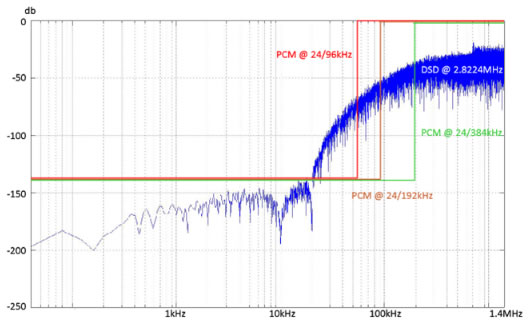
Compared with PCM DSD has a bigger dynamic range and a substantially wider bandwidth.
The downside is the quantization noise. In case of DSD64 this noise creeps up close to the 20 kHz so inside our audible range.
176/24 PCM and DSD64 are about the same resolution, they just have different distortions. Thus it seems a matter of preference which one is "better". However, converting between them is not such a great idea as the mismatch retains the worst aspects of PCM (smeared transients from the filters) and DSD64 (high frequency noise that starts at 25 kHz). DSD128 does not seem to have the problem with high frequency noise that DSD64 has, so this tradeoff seems moot, at least on my system.
Converting PCM to DSD
DSD has become the new holy grail of the audiophile community.
Hence DACs accepting DSD for input become available.
There are reports on the internet that converting PCM to DSD sounds different (and better of course, it is DSD!).
Archimago performed some measurements.

PCM test signal 1 kHz

Realtime conversion to DSD (JRiver)
Obvious, the result of the conversion is measurably different from the source.
However, the added distortion didn’t sound bad.
Archimago sums it up nicely:
I can't help but wonder if what's happening here is like tube amps and analogue playback (eg. vinyl). Objectively the DSD conversion adds distortion but the anomalies are not perceived as objectionable and in some material, the added noise and imprecision actually makes it sound less "sterile", "clinical", more "real" (conversely being in an anechoic chamber is disturbingly unreal due to the profound silence). It would make sense to me that some people could prefer DSD64 over DSD128 upconversion since DSD64 will give you more of that distortion. Even though the noise is ultrasonic in nature as measured off the DAC, nonlinearities in the playback system like your headphones and speakers (perhaps certain amps as well) could create audible intermodulation. Maybe for certain music, this could be especially beneficial.
References
- Direct Stream Digital - Wikipedia
- Accuphase DP-85 SACD player - Michael Fremer - Stereophile Sep 22, 2002
- Weiss Saracon - Bruce Brown on What's Best Forum
- Computer Audio Asylum - Charles Hansen
- Why 1-Bit Sigma-Delta Conversion is Unsuitable for High-Quality Applications
by Stanley P. Lipshitz and John Vanderkooy - Audio Research Group, University of Waterloo - Waterloo, Ontario N2L 3G1, Canada - Audibility of a CD-Standard A/D/A Loop Inserted into High-Resolution Audio Playback - E. Brad Meyer and David R. Moran - J. Audio Eng. Soc., Vol. 55, No. 9, 2007 September
- DoP Open Standard. Method for transferring DSD Audio over PCM Frames - Andreas Koch, Andy McHarg, Gordon Rankin, Michal Jurewicz
- Q&A with Thorsten Loesch of AMR/iFi Addendum: PCM vs DSD - Michael Lavorgna - 2014
- PCM to DSD Upsampling Effects (JRiver MC19 Beta) - Archimago's Musings